A quick note: this article is general information, not personal advice. Tax and accounting rules change and everyone's situation is different, so please don't act on anything here without checking how it applies to you. We'd be happy to help — get in touch before making any decisions.
Gillingham is easy to underestimate. It has no castle and no cathedral, and for centuries it sat quietly in the shadow of its grander neighbours, Rochester and Chatham. Yet Gillingham is the largest of the Medway towns, and its business history is one of the most distinctive in Kent: a story of seafarers, soldiers, engineers and — above all — the tens of thousands of ordinary working households that powered the naval dockyard next door.
Key takeaways
- Medieval Gillingham lived from the water and the land — fishing, oyster dredging, orchards and grazing on the Medway marshes, with corn and produce shipped from wharves on the Strand.
- Its most famous son, Will Adams (born 1564), became the first Englishman to reach Japan and adviser to the Shogun — a reminder that Medway seamanship travelled a very long way.
- From 1812 the Royal Engineers made Brompton, on Gillingham's western edge, the home of British military engineering — a concentration of technical skill that shaped the area for two centuries.
- The Victorian dockyard extension, built from the 1860s largely on Gillingham's riverside, tripled the size of Chatham Dockyard and turned Gillingham into a fast-growing workers' town of terraces, shops and tram lines.
- Inventor Louis Brennan developed his guided torpedo and gyroscopic monorail in Gillingham — early evidence of the engineering ingenuity the dockyard economy bred.
- After the dockyard closed in 1984, Gillingham rebuilt around retail, healthcare, education and the Gillingham Business Park — today its economy is overwhelmingly small and medium-sized firms.
Fishing, farming and the Strand: early Gillingham
For most of its history Gillingham was a riverside parish making a modest living from what the Medway and the land provided. Fishermen worked the estuary; oyster dredging on the local grounds was regulated and jealously protected; and the fertile slopes behind the river carried orchards, hops and market gardens serving the growing towns nearby. Corn, fruit and bricks moved from small wharves along the Strand, and watermen ferried workers and goods up and down the river. It was never a chartered market town like Rochester — Gillingham's trade was practical, local and waterborne.
Will Adams: Gillingham's global navigator
Gillingham's most remarkable export was a person. William Adams, born in the parish in 1564 and baptised at St Mary Magdalene church, was apprenticed as a shipwright and navigator on the Thames before joining a Dutch trading expedition to the Far East. In 1600 his battered ship reached Japan — making Adams the first Englishman to set foot there. He became a trusted adviser to the Shogun Tokugawa Ieyasu, built Japan's first Western-style ocean-going ships, and helped open trade between Japan and Europe. Gillingham remembers him with the Will Adams memorial clock tower on Watling Street and an annual festival — and the story still resonates: a Medway tradesman whose skills, learned locally, proved valuable on the other side of the world.
The Royal Engineers at Brompton
Gillingham's western boundary wraps around Brompton and the Great Lines — the open high ground kept clear to defend Chatham Dockyard. In 1812 the Army established what became the Royal School of Military Engineering at Brompton Barracks, and the Royal Engineers have been headquartered there ever since. For two centuries the Corps trained surveyors, builders of bridges, railways and telegraphs, and pioneers of military aviation and diving — much of that expertise practised and taught in Gillingham. The garrison shaped the local economy too: generations of Gillingham publicans, outfitters, grocers and landladies did steady business with the barracks, and the Royal Engineers Museum on Prince Arthur Road remains one of Medway's cultural anchors.
The dockyard extension: Gillingham becomes a town
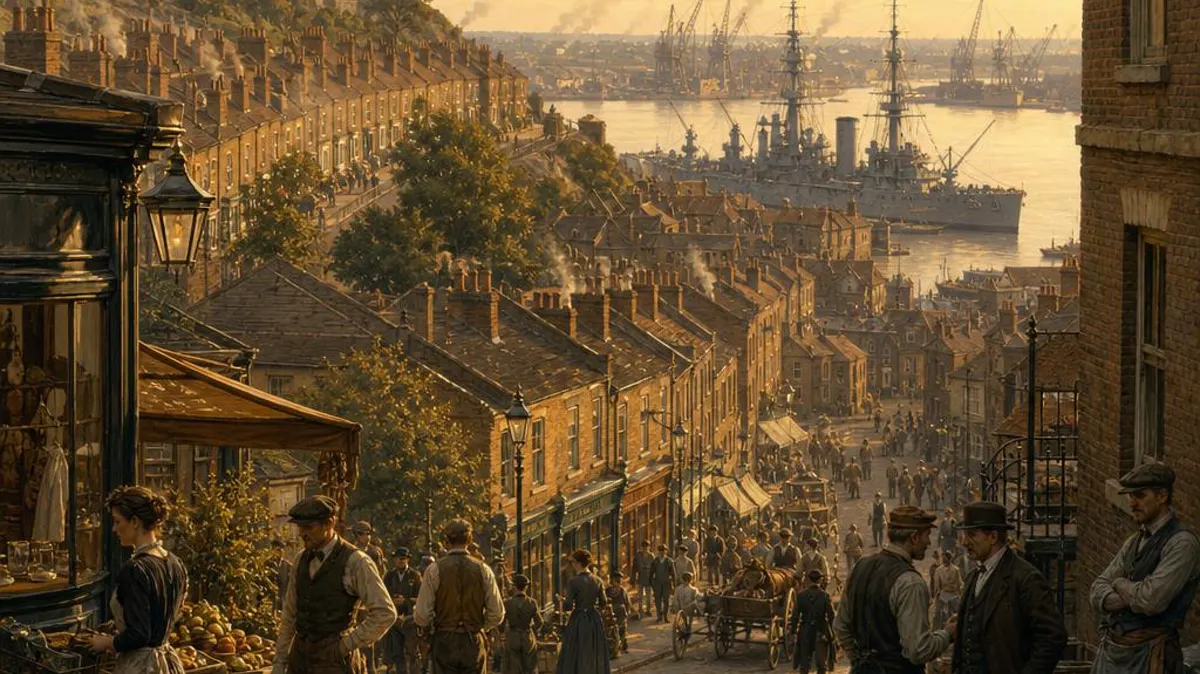
The event that transformed Gillingham was the enormous Victorian extension of Chatham Dockyard, begun in the 1860s and built substantially on St Mary's Island and the riverside within Gillingham parish. Three vast basins and new dry docks tripled the size of the yard and re-equipped it for the age of iron and steam. The workforce grew to many thousands, and they had to live somewhere: Gillingham's population roughly quadrupled in the second half of the nineteenth century as speculative builders ran up street after street of terraced housing between the High Street and the river. New Brompton, as the district around the station was known, filled with shops, chapels, schools and public houses; trams (and later buses) carried shifts of shipwrights, fitters and boilermakers to the dockyard gates. Gillingham had become, in effect, the dormitory and service town of the biggest industrial employer in the South East.
Brennan's torpedo and monorail: dockyard-town ingenuity
That concentration of engineering skill produced some genuinely exotic flowers. The Irish-Australian inventor Louis Brennan came to Gillingham in the 1880s when the War Office adopted his wire-guided torpedo — arguably the world's first practical guided weapon — and manufactured it at a purpose-built factory on the Gillingham riverside, with installations defending the Medway approaches. Brennan stayed, and went on to develop his extraordinary gyroscopically balanced monorail, demonstrated to astonished audiences in 1910. Neither invention made him rich, but both say something about the place: a town whose working population could build more or less anything.
Twentieth-century Gillingham: football, shops and the yard
Edwardian and interwar Gillingham consolidated into Medway's biggest town. The High Street became one of the area's principal shopping streets; Gillingham FC — Kent's only Football League club for most of the century — settled at Priestfield; and the dockyard, through two world wars, kept the town in work building and repairing warships and, later, refitting submarines. Alongside the yard grew smaller employers: engineering shops, laundries, brickfields on the town's rural fringes towards Rainham, and the market gardens that still fed London.
After 1984: rebuilding around small business
The closure of Chatham Dockyard in 1984 hit Gillingham as hard as anywhere in Medway — thousands of its residents worked in the yard or in businesses that depended on it. The recovery took time, but it changed the shape of the local economy for good. Gillingham Business Park, developed from the 1980s on the eastern side of the town, attracted distribution, light manufacturing, technology and office employers. The Medway Maritime Hospital in Gillingham became one of the area's largest employers in its own right; the universities at nearby Chatham Maritime brought students and staff; and retail consolidated at Hempstead Valley, one of the country's earliest covered shopping centres. Most importantly, employment scattered from one giant employer into thousands of small firms — trades, contractors, healthcare practices, hauliers, food businesses and professional services across ME7 and ME8.
What Gillingham's history means for its businesses today
The pattern in Gillingham's story repeats across Medway: skills outlast the institutions that created them. The dockyard and the Royal Engineers are why north Kent still has an unusual depth of engineering, construction and technical trades — and today's owner-managed firms are their heirs. We work with that community every day: businesses and landlords in Gillingham, trades and contractors in Rainham, and owner-managed companies across Kent. For the wider story of how the towns around the dockyard earned their living, read our companion piece on the business history of the Medway towns.
If you run a business in Gillingham or Rainham — or you're about to start one — book a free intro consultation and let's talk about the numbers behind your next chapter.