A quick note: this article is general information, not personal advice. Tax and accounting rules change and everyone's situation is different, so please don't act on anything here without checking how it applies to you. We'd be happy to help — get in touch before making any decisions.
Every county has a town where the roads, the river and the money meet. In Kent, that town is Maidstone. It has been the county's administrative and commercial capital for centuries — not because of a dockyard or a cathedral, but because of something more durable: its position at the heart of Kent's richest farmland, on a navigable river, at the crossing point of ancient routes. Maidstone's business history is the history of Kent's economy in miniature.
Key takeaways
- Maidstone grew as a market town on the River Medway, shipping Kentish ragstone, timber and corn downriver and serving the farms of the Weald and the North Downs.
- Kentish ragstone quarried around Maidstone built the Tower of London, Westminster Abbey and much of medieval London.
- From the 1740s James Whatman made Maidstone the home of the world's finest paper — Whatman paper from Turkey Mill was used by artists, printers and governments across the globe.
- The town became the centre of Kent's hop and brewing trade — Fremlin's brewery was once the largest in the county — and of fruit growing, seed merchants and agricultural supply.
- Early twentieth-century Maidstone had a surprising industrial edge: Tilling-Stevens buses, Sharp's toffee and the beginnings of the Rootes motor empire all called the town home.
- Modern Maidstone runs on services — county administration, law, healthcare, retail and professional firms — with business parks and a large, prosperous residential hinterland.
Stone, corn and the river: medieval Maidstone
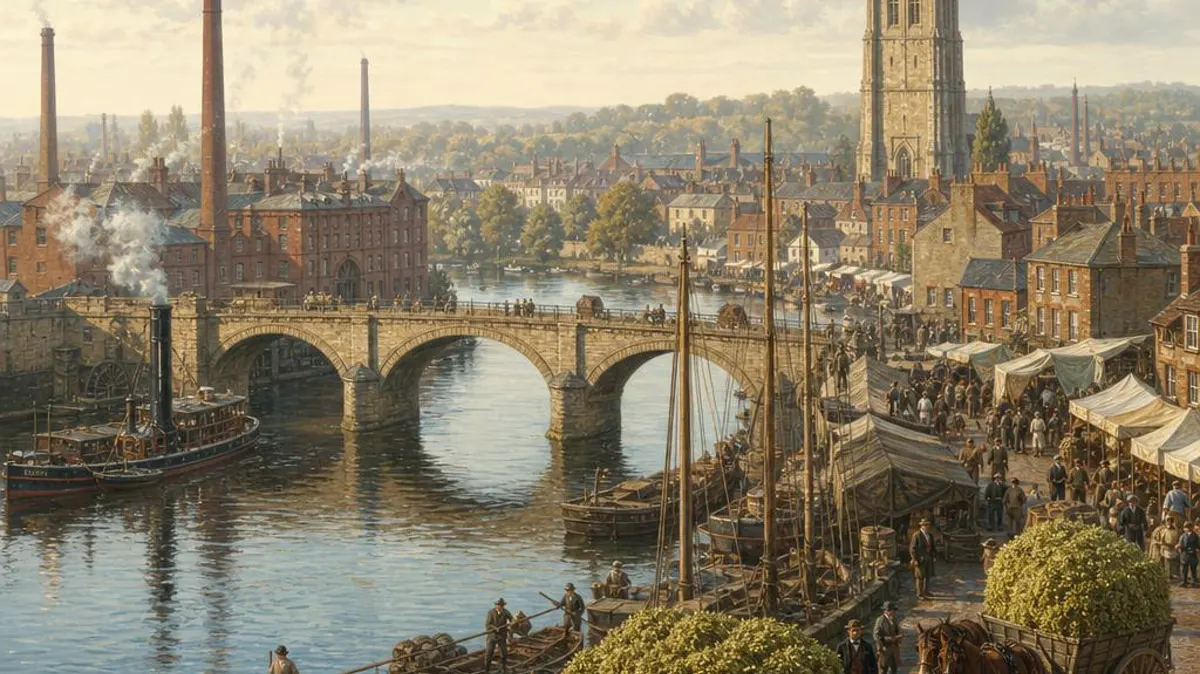
Maidstone stands where the ancient trackway along the greensand ridge fords the River Medway. The Archbishops of Canterbury kept a palace here, and around it grew a classic market town: a broad High Street running up from the river, market rights formalised by charter, and wharves handling the trade of mid-Kent. The heaviest cargo was stone. Kentish ragstone, quarried in and around Maidstone, was medieval England's most important building stone in the south east — barged down the Medway and round to London to build the Tower of London, Westminster Abbey and the city's walls and churches. Corn, timber, wool and fruit followed the same route, and the river made Maidstone the natural collection point for the produce of the Weald.
The town's merchants prospered enough to rebuild their church, All Saints, on a grand scale, and Maidstone's role as the county's meeting place hardened into permanence: assizes, quarter sessions and county administration settled here, and with them came lawyers, innkeepers and money.
Whatman's paper: a world-beating product from the Medway valley
Maidstone's most celebrated industry began with water. The fast, clean streams feeding the Medway — the Len and the Loose stream — powered fulling and corn mills for centuries, and from the late 1600s papermakers adapted them. At Turkey Mill, just east of the town, James Whatman and his son perfected wove paper in the mid-1700s — a smoother, finer sheet than anything made before. "Whatman" became the world's benchmark for quality paper: Turner and Gainsborough painted on it, and governments and engravers everywhere specified it. Papermaking spread along the valley — at Tovil and beyond, the Green family and later mills made Maidstone one of England's great paper towns, an industry that survived into living memory.
Hops, beer and the Garden of England
If paper made Maidstone famous, agriculture made it rich. The town sat at the centre of the Kentish hop gardens and fruit orchards — the Garden of England — and everything the farms needed and produced passed through it. Hop factors, seed merchants, maltsters, agricultural engineers and fruit brokers clustered in the town; every September the hop-picking season brought tens of thousands of London families into the surrounding parishes. And where there are hops there is beer: Maidstone brewed on a serious scale, and Fremlin's brewery on Earl Street — with its famous golden elephant trademark — grew into the largest brewer in Kent before the industry consolidated in the twentieth century. Style & Winch and other Maidstone brewers supplied hundreds of pubs across the county.
Toffee, buses and motor cars: the industrial county town
Edwardian and interwar Maidstone had a genuinely diverse industrial base, much of it now half-forgotten. Sharp's made its Kreemy Toffee in the town by the ton, becoming one of Britain's best-known confectioners. Tilling-Stevens built petrol-electric buses on St Peter's Street that ran in cities across Britain and the empire. And in 1917 William and Reginald Rootes moved their father's cycle and motor business into Maidstone — the seed of what became the Rootes Group, one of Britain's largest car makers (Hillman, Humber, Sunbeam, Singer). The county town also housed the county's institutions: the prison, the barracks, the county council, courts, hospitals and newspapers — every one of them an employer and a customer for local business.
The modern economy: services, professions and property
Maidstone's twentieth-century industries faded the way most British manufacturing did — the last town-centre brewing ended, toffee and buses moved on, and papermaking contracted — but the town's underlying advantages never went away. Today Maidstone has one of the largest economies in Kent, built on public administration, law and professional services, healthcare, education, retail and construction, with business parks at Eclipse Park and along the M20 corridor and a growing medical campus at Junction 7. The borough's residential property market is among the county's most active — which is why so much of our work for Maidstone clients involves landlords and property investors — and the town centre, the courts and the hospitals sustain a deep bench of professional practices, agencies and owner-managed firms across ME14, ME15 and ME16.
What history teaches Maidstone businesses
Maidstone's story carries the same lesson as the rest of the Medway valley: the businesses that lasted were the ones that traded on the town's permanent advantages — its position, its market, its professions — rather than any single product. Ragstone gave way to paper, paper to beer, beer to services; the market function endured through all of it. We act for businesses, landlords and individuals in Maidstone and across mid-Kent, from owner-managed companies to property investors, and for the wider region's story you can read our companion piece on the business history of the Medway towns.
If you run a business in the county town — or you're weighing up buying property, incorporating or planning an exit — book a free intro consultation and we'll explain how we can help and what it would cost.