A quick note: this article is general information, not personal advice. Tax and accounting rules change and everyone's situation is different, so please don't act on anything here without checking how it applies to you. We'd be happy to help — get in touch before making any decisions.
Drive out of Strood along the A228 and the towns fall away fast. Within minutes you are on the Hoo Peninsula — the broad tongue of farmland and marsh between the Thames and Medway estuaries, scattered with villages whose names sound like the landscape: Cliffe, Cooling, High Halstow, Hoo St Werburgh, Allhallows, Grain. It looks like empty country. It is anything but. Few places in Kent have hosted such a succession of serious industries, from medieval sheep runs to one of Europe's biggest gas terminals.
Key takeaways
- For centuries the peninsula's wealth was its marshland grazing — sheep, corn and salt — with produce shipped from tiny wharves to London; Dickens set the opening of Great Expectations on these marshes at Cooling.
- The Victorian era brought heavy industry to the river edges: brickfields, cement works at Cliffe, and fleets of Thames sailing barges carrying bricks and cement to build London.
- Cliffe also hosted one of Britain's largest explosives works, and the peninsula bristled with forts and defences guarding the approaches to Chatham Dockyard.
- The Hundred of Hoo Railway (1882) and the ambitious resort scheme at Allhallows-on-Sea show how often outside investors have tried — and struggled — to remake the peninsula.
- The twentieth century industrialised the eastern end on a giant scale: the oil refinery and later Grain LNG terminal on the Isle of Grain, Kingsnorth power station, Damhead Creek and the London Thamesport container terminal.
- Today the peninsula mixes agriculture, energy, logistics and village trades — and its businesses are served from our Rochester office a few minutes down the A228.
Sheep, salt and Dickens' marshes
The Hoo Peninsula's first economy was grass. Its reclaimed marshes were some of the finest sheep pasture in England, and from the Middle Ages the parishes of Hoo, Cliffe and Cooling lived from wool, mutton, corn on the higher ground, salt-making along the creeks, and fishing and wildfowling on the flats. Produce went to London by water — the peninsula is closer to the capital by river than by road even now. It was a hard, ague-ridden landscape, and its atmosphere is preserved forever in literature: Charles Dickens, who lived at Gads Hill on the peninsula's landward edge, opened Great Expectations in Cooling churchyard, where the little lozenge-shaped graves that moved Pip can still be seen.
Bricks, cement and barges: building London from the marshes
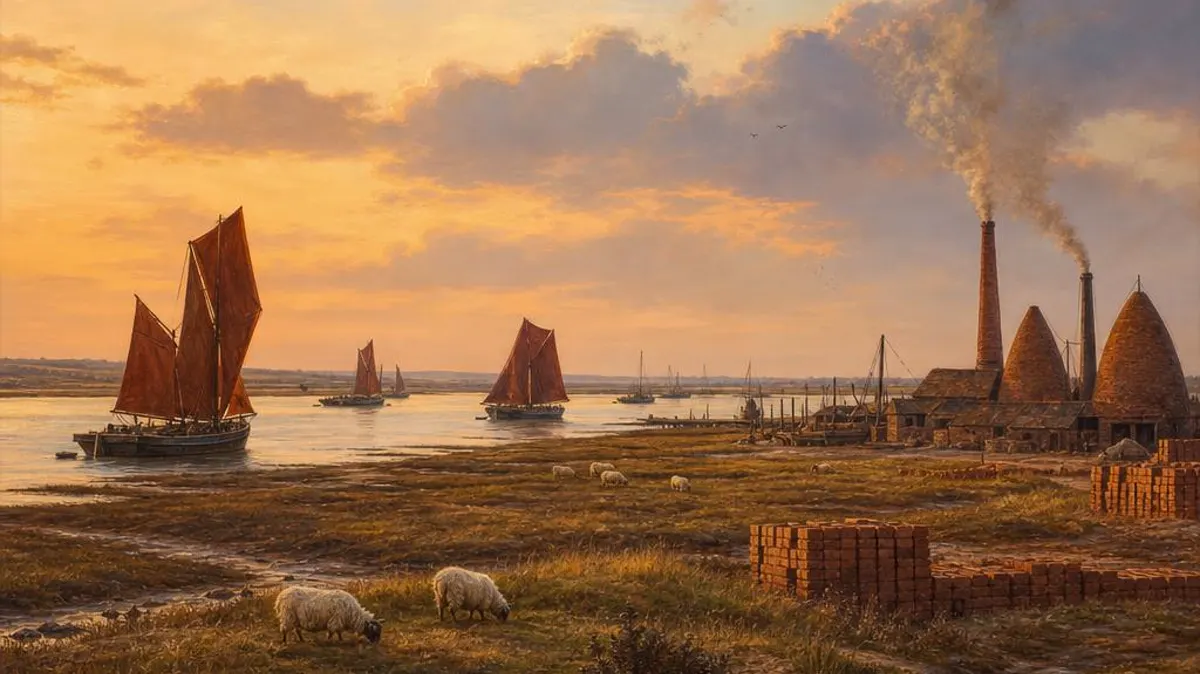
In the nineteenth century London's insatiable appetite for building materials reached the peninsula. The brickearth of the Thames shore fed brickfields around Cliffe and along the estuary, part of the great north Kent brickmaking belt that stretched east through Rainham and out to Sittingbourne and the Swale. At Cliffe, chalk from the quarries met river transport and a major Portland cement works grew up from the 1860s, its remains still visible in the flooded pits along the shore. Bricks and cement left by water: Thames sailing barges loaded at wharves and creeks all around the peninsula, sailed up to London with building materials, and came back with the city's ash and refuse to fire the next season's bricks. It was a remarkably circular economy, run on wind and tide.
Explosives, forts and the defence economy
Remoteness has economic value too. From 1892 the marshes at Cliffe hosted the Curtis's & Harvey explosives works, which grew into one of Britain's largest — hundreds of workers producing gunpowder, cordite and later TNT in isolated blast-proof buildings scattered across the levels, especially during the First World War. The military shaped the peninsula in other ways: coastal forts at Cliffe, Hoo and Darnet islands and Grain guarded the approaches to Chatham Dockyard, and garrisons, gun testing and later air and naval establishments at Grain brought wages and contracts to the villages for over a century.
Railways, resorts and big ideas
Outside money has always seen possibilities in the peninsula's empty spaces. The Hundred of Hoo Railway opened across the marshes in 1882, and Port Victoria at its end was briefly a genteel steamer pier used by royalty. In the 1930s promoters tried to conjure a seaside resort at Allhallows-on-Sea, complete with a branch line and grand plans for hotels and pleasure gardens; the resort never took off, though the holiday park remains. Later decades brought proposals for airports on the Cliffe marshes and at Grain — repeatedly studied, repeatedly rejected. The pattern is striking: the peninsula rewards industries that genuinely need what it has — space, deep water, isolation — and defeats the rest.
Oil, gas and containers: the industrial east end
The industries that did stick are enormous. The Isle of Grain, at the peninsula's seaward tip, hosted one of Britain's largest oil refineries from the early 1950s until 1982; its deep-water site was reborn as Grain LNG, now one of Europe's largest liquefied natural gas import terminals, alongside power stations and National Grid infrastructure. At Kingsnorth, on the Medway shore, a giant oil- and coal-fired power station ran from the 1960s until 2013, and Damhead Creek's gas-fired station continues the energy tradition. Next door, London Thamesport opened in 1990 as one of the UK's first fully computerised container terminals. Energy, logistics and utilities remain the peninsula's biggest private employers, alongside modern farming on some of the best arable land in Kent — and village economies of trades, contractors, equestrian businesses and tourism serving nature reserves like RSPB Cliffe Pools and the Saxon Shore Way.
What the peninsula's history means for its businesses
The Hoo Peninsula's story is a lesson in playing to your assets. Its businesses have always prospered by using what the landscape offers — grazing, brickearth, deep water, space — and by staying nimble when the big industries moved on. Today's peninsula firms — farmers, hauliers, engineers, energy contractors, village trades and holiday businesses — are the latest chapter, and they are on our doorstep: our office sits just down the A228 on the Medway City Estate, itself built on the peninsula's Frindsbury corner. We act for businesses and landlords across Strood and the villages, and across the wider Medway area. For the towns' side of the story, read our companion piece on the business history of the Medway towns.
If you farm, build, haul or trade anywhere on the peninsula — or you're planning to — book a free intro consultation and we'll explain how we can help and what it would cost.